
Worksite information
Welcome to Heinola Fluting Mill!
Safety is of utmost importance at Heinola Fluting Mill and something we develop continuously. Our target is zero accidents, which we can only achieve by following instructions and regulations together.
We expect all safety incidents, unsafe activities as well as order and tidiness to be dealt with actively to ensure that every person returns home healthy.
We hope to see everyone working at the mill taking part in developing safety by intervening in unsafe work and making safe behavioural observations. By continuously developing procedures and finding safer working methods, we can make Heinola Fluting Mill a safer place to work.
Ari Pöntinen
Mill Director, Heinola Fluting Mill, Stora Enso Oyj
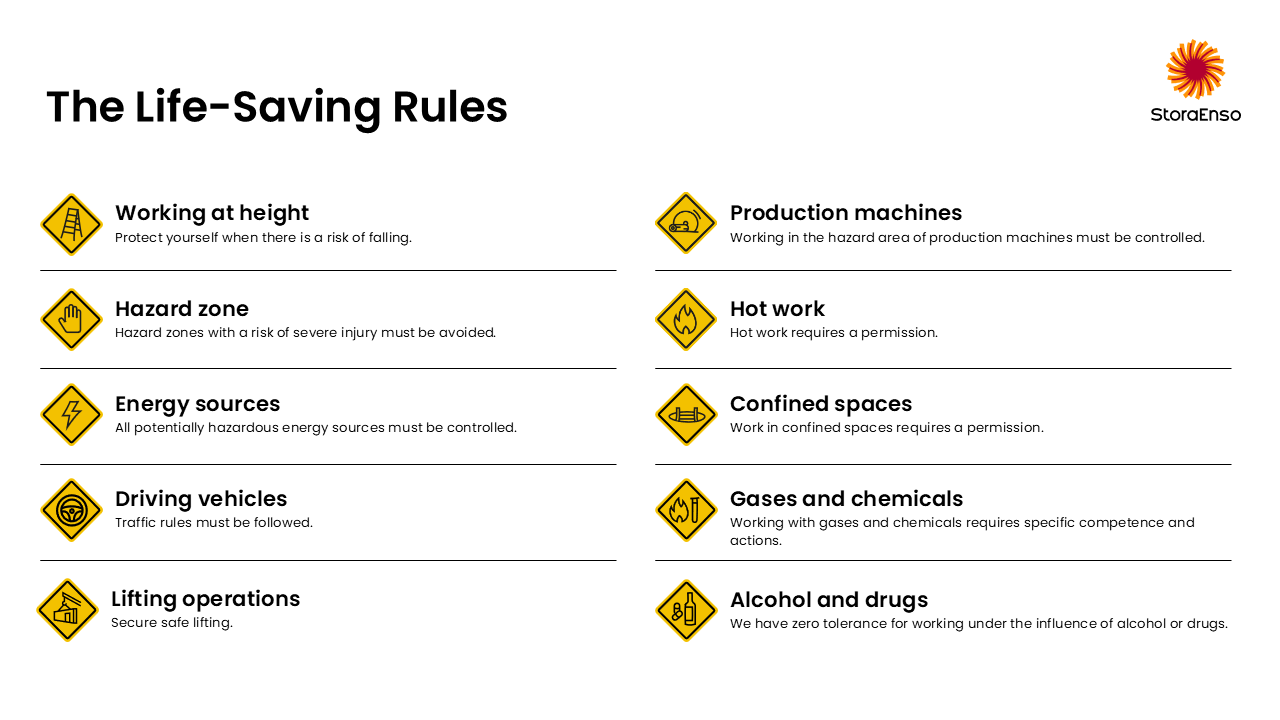
10 Life-Saving Rules
Basic competence requirements
- Valid occupational safety card
- Valid incipient fire fighting competence (required from all persons working in the mill area)
- Identity card with picture and tax number
- Valid occupational safety induction (valid for 2 years)
- Valid hot work license for hot work operators and guards l Work permit for workers from outside the EU
- For users of personnel lifting devices and forklifts a writ- ten permit issued by the employer and the permission of the owner of the device to use the device in question
- Other qualifications based on the work to be performed
Work permits
Each job must have a permit before work begins. Permits can be acquired from separately specified control rooms from persons authorised by Stora Enso.
Permit types:
- Mobile crane erection permit
- ATEX permit
- Device induction and loan permit
- Excavation permit
- Confined-space work permit
- Hot work permit
- Work permit
NB! Every company working at the same confined-space worksite must have their own confined-space work permit.
Contact details
Stora Enso Safety Personnel
- Mikko Nurminen, Safety and Occupational Health Manager, tel. +358 40 595 3950
- Petri Tuovinen, Safety Manager, tel. +358 44 7429 783
- Tommi Soikkeli, Safety Engineer, tel. +358 40 356 4416
Emergency number: 112
Heinola health care center
Torikatu 13, 18100 Heinola, tel. +358 3 849 4388
Open: Mon–Fri from 8 am–4 pm
Central Hospital Päijät-Häme Lahti
Keskussairaalankatu 7, 15850 Lahti, tel. +358 3 819 11
Open: 24 h
Emergency service: Akuutti24, tel.116 117
Heinola taxi service
Tel. +358 400 351 407
Gates' contact details
Heinola Fluting Mill
Address: Tampellantie 1, 18100 Heinola
Tel. +358 44 742 9528
Emergency call
Emergency number: 112
When placing the call, state:
- who you are
- what has happened
- where it happened
- is anyone in danger
Answer any questions.
Do not end the call before you are told to do so.
Arrange for someone to show the way.
Hazardous chemicals in the mill area
-
Hydrogen sulphide
-
Sulfur dioxide
-
Boiler ash from incineration plants using biofuels
Lifting and tools
- Special lifting requires written lifting plans
- Written commissioning inspections must be carried out for mobile cranes
- Daily commissioning inspections for personnel lifting devices are carried out by the supervisors of the company using the device and under the supervision of whom the user of the device works.
- The supervisors of the company using the personnel lifting device grant the permits to its personnel to use the device. The permit is recorded in, for example, a notebook from where the granting of the permit can be checked before the device is taken into use.
- The lifting tools must be in good shape and inspected
Mill Canteen
The restaurant Antell Rautsalo serves us at the mill.
Please find the menu here. Lunch is served Mon-Fri at 10.15–13.00
- Tel.: +358 2077 02180
- Email: antell.rautsalo@antell.fi
Moving in the area
Rules when moving around at the mill site
1. Traffic in the mill area is limited as much as possible
2. The general speed limit in the mill area is 20 km/h
3. When moving around the area, general traffic rules must be followed and taken into consideration:
- light traffic (pedestrians, cyclists, cars)
- heavy lorry traffic (wood raw material, chemicals, pulp)
- train traffic (wood and pulp cars)
- heavy work machine traffic
- maintenance traffic
4. Stora Enso is not responsible for any damage to cars in the mill area
Personal protective equipment
Always when working at the mill:
- helmet
- protective goggles (sealed model if required), also when moving around outside
- protective gloves
- hearing protection
- protective footwear
- high visibility clothing EN 471-2 (when moving around outside or in warehouse)
- long-sleeved work clothing
Protective clothing according to the situation.
When handling chemicals, chemical pipelines and chemical equipment, a full protective mask must be worn and the instructions of the safety data sheet must be adhered to.
Basic work clothes in maintenance, service and installation work are a work jacket and/or long- sleeved work shirt and trousers, bib-and-brace overall combination outfit or coverall. The protective clothing must be worn so that the outfit covers both the upper and lower body, neck, arms and legs.
When using a personnel lifting device, fall protection must be worn and a safety rope must be attached in order to prevent falling.
Full face mask with ABEK-P3 filter for gases.
At least an FFP3 class mask is required at the effluent treatment plant.
A welding helmet for welding and ALWAYS a fresh air breathing apparatus in stainless steel welding.
Concentration meter in all confined spaces, also in other work if required.
NB! For work in the power plant's liquor line area, the work team must have a hydrogen sulphide concentration meter (H2S) and in the odorous gas boiler area (HK1, HK2, HK3/IMAGE project) a sulphur dioxide concentration meter (SO2).
Preparing for emergency situations
Accident
- The supplier must have sufficient first aid equipment and trained personnel at the site
- If necessary, there are first aid equipment in the garages and control rooms
- At the start of the work, you must familiarize yourself with the area's emergency showers and eye rinsing points
Fire
In addition to minimum fire extinguishing equipment and protective equipment, persons carrying out hot work must be equipped with at least one 25-39 mm / 20 m fire hose with a 2" claw connector and a matching nozzle.
Gas hazard
- The supplier brings the required personal protective equipment and concentration meters to the worksite
- When work starts at the worksite, workers must familiarise themselves with the area's fire and emergency instructions and the location of the defibrillators in the mill area
- Review how to call for help and the locations of the gas shelters beforehand.
In emergencies, always call 112. Also inform shiftmaster (p. 044 742 9785) and gate (p. 044 742 9528)
Always inform work supervisor in case of accidents and safety observations
Safety
Safety goals
- Our goal is zero accidents in everything we do.
- One safety observation/person, also service providers.
- Demanding lifting work requires a lifting plan and an assembly inspection for mobile cranes.
- Work permit for each job.
- A written risk assessment for a job must be done before the work begins and the worker must have it with them when the work is performed.
- Safety rounds are scheduled ahead of time and carried out according to the schedule. Follow-up at shutdown meetings.
- The main supplier of the work for the investment and major repair work must draw up a written safety plan.
Repeated failure to obey safety rules results to a removal of the person from the mill area for a year.
Safety training
To be allowed to work in the mill area, you must have completed:
- an occupational safety card
- first-aid course
- first-aid fire-fighting training (minimum requirement)
- Stora Enso's general safety induction
- Heinola Fluting Mills' local safety induction
- department-specific safety briefing
You can complete Stora Enso's general safety induction and Heinola Fluting Mills' local safety induction in the following address:
http://elearning.fi/storaenso/turvainfo/
Password: sesafety
The general induction takes around an hour to complete. The local induction takes around 10 min and it must be completed in one go for it to be saved. The completed induction is valid for two years.
The department-specific safety briefing takes place at the mill.
Scaffolding
- Scaffolding must only be built according to building safety regulations, such as work scaffold ramps: Government Decree on the Safety of Construction Work (205/2009), chapter 11 (see: section 64) and chapter 12 (see: section 67)
- The inspected scaffolding must include a scaffold tag
- The commissioning inspection is carried out by the builder of the scaffolding and by the scaffolding contractor or their representative
- Work carried out at height is done using suitable scaffolding or a personnel lifting device. A leaning ladder must not be used as a work platform.
- A-frame ladders must not be used if the work requires the use of electrical tools or tools requiring the use of force.
- Before using an A-frame ladder, check that the legs of the ladder are resting on a hard and level surface.
Restricting the work area
Sufficient work site area restrictions must be in place when carrying out lifting work, personnel lifting device work and other work that requires restricting the area. Suppliers must be equipped with adequate marking and restricting equipment when coming to work.
Staff facilities
Contact the following people to enquire about available staff facilities:
Petri Tuovinen, Safety Manager, Stora Enso, +358 (0) 44 7429 783
Safety observations
In order to prevent accidents we strongly encourage you to report any safety risk you might discover. To make a safety observation you click here.
Tidiness and order
Tidiness and order are prerequisites for safe work. Once the work is completed, the contractor must remove from the worksite all temporary structures and scaffolding, installation equipment and waste and leave the area in a safe state.
Waste management
The party carrying out the work is responsible for waste sorting and for taking it to the collection point. The work is ready when the final clean-up of the worksite is completed.
Hazardous waste must be separated from other materials to avoid safety risks and the contamination of the other materials so that they become unusable.
Waste that can be used as material:
- paper
- clean cardboard
- metals
- glass
Energy material:
- clean energy fraction
- energy fraction
Other fractions:
- biowaste
Landfill fractions:
- material that is not suitable for the previous fractions
Hazardous waste is separated, marked and packaged appropriately and carefully.
Why sorting is worthwhile?
- Waste in the wrong place can cause chemical reactions
- Material can be reused
- Waste can be processed into energy
- Makes economic sense
For the duration of shutdowns, the number of collection bins and pallets will be increased as needed and they will be emptied more frequently. The locations of additional pallets will be revealed before the work is begun by the contractor at each worksite.
If the clean up has to be performed by the orderer after the subcontractor, the subcontractor will be sent an invoice for the clean-up in question.
Workforce registration procedure, access permits and contractor's obligations
1. Company verification and reporting
The contractor and its subcontractors must demonstrate compliance with contractor liability obligations during procurement by submitting the required documentation to Stora Enso. Notification is done electronically via the Zeroni system.
- Companies receive login credentials to Zeroni during procurement if they do not already have them.
- Register your company and subcontractors at Zeroni.
The company must be prepared to prove contractor liability compliance by providing:
- Certificate of registration in the prepayment register, employer register, and VAT register.
- Trade register extract.
- Certificate of tax payment status.
- Proof of pension insurance and payment or a payment agreement for overdue contributions.
- Statement of applicable collective agreement or key employment terms.
- Proof of occupational health care arrangement with a Finnish provider.
- Proof of statutory accident insurance.
- Documents must be submitted in Finnish, Swedish, or English.
2. Worker Registration and Access Permit
A worksite permit application must be submitted for each individual, including all required documents.
- Register workforce at Zeroni.
- Worksite permits must be submitted:
- For Finnish workers: at least 7 days before work begins.
- For foreign workers: at least 14 days before work begins.
An approved worksite permit grants access rights to the factory.
Ensure your site contact is informed and approves the permit requests in time.
Each worker must collect their access badge in person. Identity verification and presentation of the company ID card are required upon collection.
Workforce Information Requirements
For Finnish workers:
1. First and last name, tax number, date of birth, phone number, contact person, nationality, employment type, subcontracting chain, company, and company contact.
2. Construction site ID card with photo, name, tax number, employer name, and business ID.
For foreign workers:
1. First and last name, Finnish tax number, date of birth, phone number, contact person, nationality, type of employment, subcontracting chain, company and company contact person
2. Address in the home country
3. Citizens of EU and EEA countries:
- Copy of passport or other travel document.
- Certificate of pension and accident insurance coverage in the home country (A1) or proof of equivalent insurance taken out in Finland.
- Copy of a construction site ID card that meets site requirements.
4. Citizens of countries outside the EU and EEA:
- Copy of passport or other travel document
- Certificate of pension and accident insurance coverage in the home country (A1) or proof of equivalent insurance taken out in Finland
- Copy of work permit/visa
- Construction site ID card that meets site requirements
5. The person’s contact person in Finland and their contact details.


