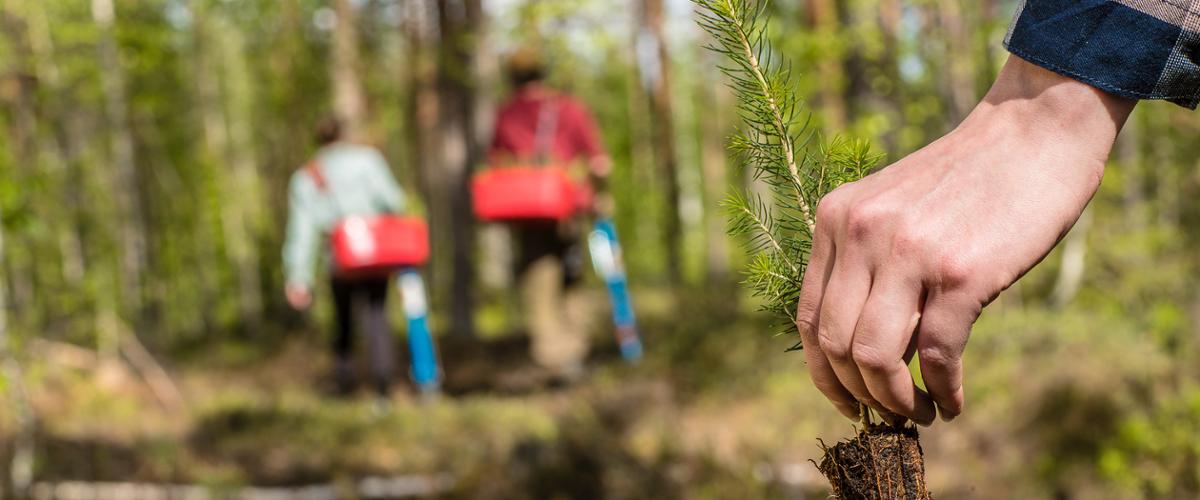
In its annual report, Stora Enso reports the seedlings planted in own forests or delivered to other forest owners: a little over 20 million of the seedlings end up in our own forests in Sweden, and more than 19 million were planted on private forest owners’ lands in Sweden, Finland, Norway, and the Baltics. In addition, we delivered approximately 23 million seedlings to other external customers, such as other forestry companies.
Forest regeneration is a crucial part of even-aged forestry – the most common forest management method in Northern Europe. When new trees are planted after final fellings, we make sure there will be new forest growing to replace the felled trees. This is also required by law.
Seedlings are bred in nurseries for growth, strength and resilience
Planted seedlings are grown in nurseries – both in Store Enso’s own nurseries in Sweden as well as by suppliers in Finland and the Baltics. The seedlings are grown from seeds produced in tree breeding programmes to enhance growth and other characteristics over time. These programmes are set up to ensure that the tree seedlings will be fit to the environmental conditions in the forest, now and over the decades to come.
In practice, this is done by selecting trees with characteristics that are valuable for nature, productivity and resilience and crossing them with each other to produce seeds. Some important characteristics taken into account are:
- Tree growth: well-growing trees form forests that not only have high productivity value but also help to mitigate climate change by binding carbon dioxide more efficiently from the atmosphere
- Genetic diversity: healthy forests require diverse tree species but also genetically diverse tree individuals, which is why all breeding is set up to ensure sufficient genetic variability
- Health and strength: breeding is also set up to increase trees’ natural robustness to withstand different weather conditions as well as pests and pathogens
- Resilience and climate adaptation: the above-mentioned characteristic also contribute to climate change mitigation as well as to the trees’ resilience and adaptation towards the changing climate, such as extreme weather and warmer forest environments
Combination of planted and natural seedlings enhance diversity
Over time, the seedlings planted in a regeneration area get mixed with naturally regenerated seedlings that grow from seeds in the soil. We tend the forest for the first time when trees are approximately two meters in height, and at that point we leave also some of the naturally regenerated seedlings. This results in a mixture of species and trees of various genetic origin.
Our focus remains on fostering healthy, thriving forests that will stand the test of time and the changing climate. By planting and nurturing over 62 million tree seedlings in 2024, Stora Enso is not only ensure the regeneration of forests but also aim for resilient and diverse forest ecosystems.
What comes after the planting phase? Read more on our forestry page.


