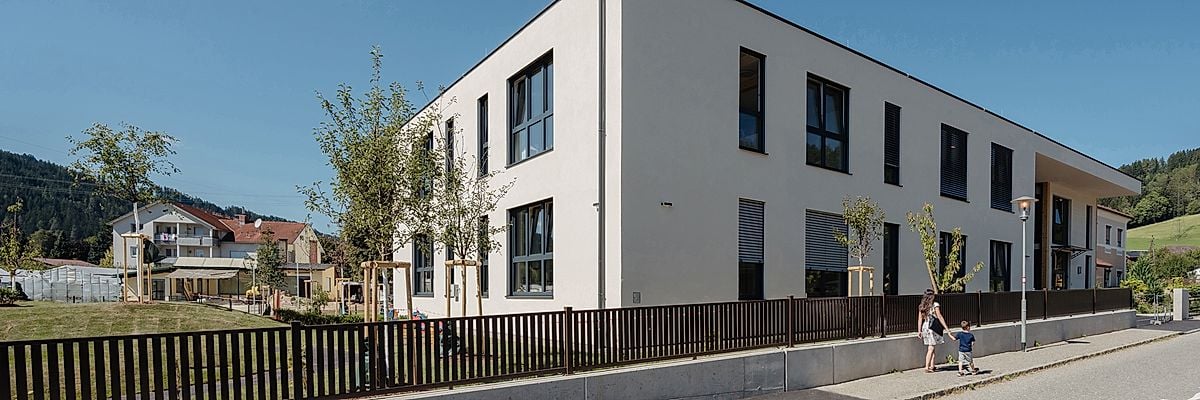
From Austria to the UK, nearly 100 educational buildings have been built using Stora Enso engineered mass-timber elements, cross laminated timber (CLT) or laminated veneer lumber (LVL) only in Europe. At the same time, researchers are increasingly examining how school environments affect concentration, stress and wellbeing. What can we learn from the classrooms where thousands of pupils spend their days?
The classroom conversation is changing
For years, discussions about school buildings have focused on practical concerns such as energy performance, budgets and construction timelines.
Today, another question is gaining attention: how do school environments affect the people inside them?
Researchers in fields ranging from environmental psychology to architecture are investigating how factors such as natural light, acoustics, air quality and the use of natural materials can influence learning environments.
As more wooden schools are built across Europe, the role of building materials has become part of that conversation.
A growing number of timber schools
Educational buildings represent one of the largest building segments for Stora Enso Building Solutions.
To date, over 100 educational buildings have been completed using Stora Enso engineered wooden elements across 17 European countries, the largest markets being United Kingdom, Austria, Finland, Germany and France.
Around half of those schools have been completed during the past five years, reflecting growing interest in wood construction for educational buildings.
Do learning environments matter?
Evidence suggests that they do. One of the most influential studies in this field, the University of Salford's HEAD project, found that classroom design can have a measurable impact on pupils' learning progress.
Researchers identified factors such as naturalness, environmental quality and the overall classroom environment as important contributors to educational outcomes.
Other studies have explored whether natural materials, including wood, can contribute to wellbeing by reducing stress, supporting concentration and creating comfortable indoor environments.
While researchers continue to debate the scale of these effects, there is growing agreement that buildings are more than just containers for learning. They are part of the learning experience itself.
“More and more young people are drawn to the beauty and warmth of wood architecture. When it comes to schools and public buildings, for us safety comes first. Modern wood buildings offer fire performance comparable to steel and concrete structures and comply with the same rigorous building code requirements”, says Gernot Weiss, Head of Sales, Building Solutions, in Stora Enso.
The science behind wood and wellbeing
Researcher David Fell from the University of British Columbia is among the academics who have studied the relationship between wood and human wellbeing.
His work suggests that wooden interiors can influence physiological responses associated with stress.
A broader review conducted by researchers at the Technical University of Munich examined more than 100 studies and identified recurring links between wood environments and outcomes such as lower stress levels, improved concentration and positive perceptions of wellbeing.
While researchers emphasise that no single material determines how people feel or perform, the findings contribute to a wider discussion about the design of healthy buildings.
More than a sustainability story
The growth of wooden schools is often linked to construction efficiency and climate considerations.Yet wellbeing may prove to be another important factor shaping future school design.
Architects increasingly talk about creating environments that support pupils and teachers, not only through layout and daylight, but also through the materials used throughout a building.
For municipalities planning new schools, the question is becoming broader than how a building is constructed.
It is also about the daily experience of the people who learn and work there.
Looking ahead
Over 100 educational buildings may not provide all the answers. But they do offer a growing body of real-world experience.
As researchers continue to explore the relationship between buildings and wellbeing, one thing is becoming increasingly clear: the conversation about schools is no longer only about what children learn.
It is also about where they learn.


