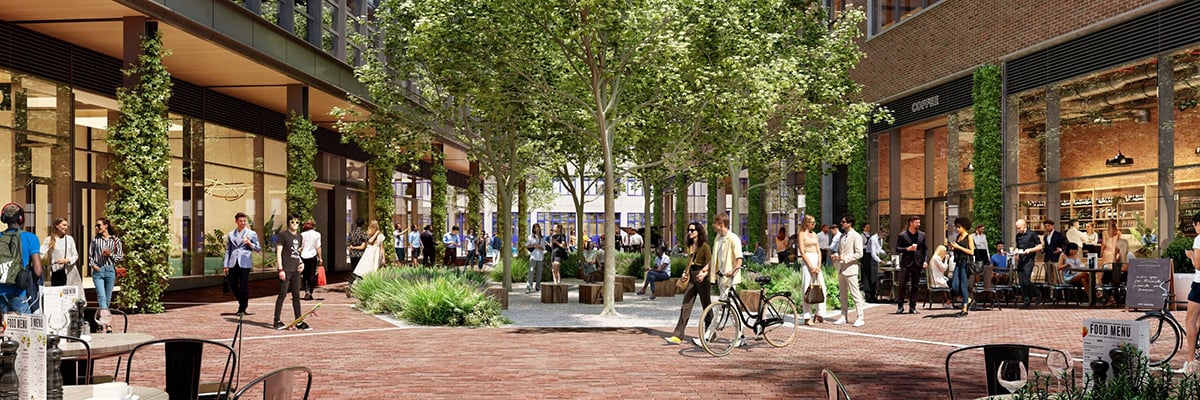
Photo: Landsec/©Bennett Associates | Stora Enso partner: Hybrid Structures
97% of property developers see net-zero emissions as commercially important to their business growth, 39% spend more than 10% of their capital expenditures on refits, according to a recent report (HSBC) and the effect is spreading.
Mainstreaming renovations
Several financing and policy initiatives to enhance resource efficiency are helping accelerate renovations with wood. The European Union’s recently enacted Energy Performance of Buildings Directive specifically intends to produce deep renovations that significantly increase buildings' energy efficiency.
The directive will support the renovation of 35 million “building units” by 2030, in part by requiring EU Member States to have national building renovation plans that include policies and measures in three areas that should support the increased use of wood and other bio-based materials:
1) Reduction of embodied and operational emissions 2) Uptake of carbon-storing materials in buildings 3) Promotion of modular and industrialised solutions for construction and building renovation.
To date, Germany is leading the retrofit race with a wide range of policies and initiatives, and many are looking to copy the successful Dutch approach too. (Global Retrofit Index) But, overall, hundreds of billions more are required to renovate Europe’s 75% energy-inefficient building stock (EEA).
Long term investments
Owners are not doing retrofits just out of need although there’s plenty of that—85% of today's buildings are likely to still be in use in 2050 (EEA). Deep retrofits lower energy bills and maintenance costs, improve asset value, and health, while providing more durability and comfort, which are good investments financially for the planet and the occupants’ well-being. (LETI)
Don’t knock it: existing building fabric upgrades
Adaptive reuse
Wood can be used for adaptive reuse projects to frame a building envelope or roof, replace window and door components or cladding, or install floor joists and infill walls. And with mass timber products, you can reduce emission-intensive concrete and steel with large-scale, commercial projects too. One of the most impressive 2024 examples is the 370,000 square foot/ 34,374 m² Timber Square in London, which prevented over 7,499 metric tonnes of greenhouse gases before it even started simply by specifying cross-laminated timber (CLT) instead of concrete and steel (SLU).

Photo: Landsec©Bennett Associates | Stora Enso partner: Hybrid Structures
The UK’s largest commercial property developer, Landsec, estimates they saved an additional 7,000 tonnes of carbon emissions by retaining 80% of the existing fabric of the 1950s printworks (UKGBC). The additional application of 6,561m³ of Sylva™ CLT Walls and Floors by Hybrid Structures, who specialise in designing and constructing structures with diverse materials, further reduced the carbon footprint while adding significant carbon storage, (4,999 tonnes) creating one of the UK’s most environmentally sustainable commercial schemes to date. The embodied carbon was tracked throughout the design. The combined figure for both sites is 248 kg CO₂e/m² which sits just above the 2030 target for the structure set by LETI. The development would even exceed this target if the carbon storage were also included in the final calculations.
Re-equip with a Sylva™ kit
Demolish and rebuild is seldom the best retrofit option, but when it is, architects are finding specifying engineered wood with excellent EPD ratings for the rebuild, like Bywater’s joint venture for developing new offices at 30-34 Old Paradise Street, London, the only way to reach their low-emission targets or the rebuild in Mayfair at 38 Berkeley Square, also by B&K, for Chanel fashion house.

Photo: ©Bywater | Stora Enso partner: B&K Structures
Keep calm
There are a number of convenient cost-saving side benefits when retrofitting with wood, given how quick and quiet it is to work with. Walls can now arrive preequipped with wood frame facades, insulation, fire-resistant lining, and rain protection as we recently saw by ACDF Industrie at Croix Saint Simon, a social housing project in Paris. The installation by Aux Charpentiers de France enabled families to stay in their homes during the renovations and avoided temporary accommodation costs.
The prefabrication was also appreciated by the workers, who had less backbreaking work of manually applying cladding on-site. And less of the thankless construction waste clean-up to do, as the bulk of that work had been automated in the factory before delivery.
Carry on
The number of examples of the side benefits of the speed keeps growing with each project. Visitors continued to come to Tekniska Science Museum while the much-celebrated extension Wisdome Stockholm took shape. Businesses on the lower levels continue to operate while the vertical extension of Marcadet Belvédère adds additional floors. The days of having to tolerate months sometimes years of loud and dirty construction seem to be numbered.
Engineered wood also simplifies notoriously hard-to-schedule renovations. Arding & Hobbs made several heritage discoveries, including a stained-glass barrel roof. While fascinating, it caused delays as a team of specialists used toothbrushes to restore it. However, specifying customised Sylva™ CLT Walls and Floors made the installation of the vertical extension (Optoppen) precisely on time and within budget.
Economic sense
The property owners of Arding and Hobbs, W. Real Estate (W.RE) secured tenants before completion and started actualising return on investment immediately, a key driver for capital-intensive projects at this scale. And further confirmation of what our partners and research tell us: the occupier market is well-informed about embodied and operational carbon and circular construction methods and are often prepared to pay a premium for it. (Cromwell Property).
So, in short, stay tuned —looks like there are many more golden oldies to come!