Published 3 January 2025
Stora Enso’s impressive new head office, called Katajanokan Laituri, reflects today's sustainable forestry practices.
Katajanokan Laituri is a prime example of what a tree can do and what we can achieve with sustainable forest management: a marvel of wooden architecture where modern, urban work life meets nature, well-being, and the renewability of the forest. Built with responsibly sourced timber, the wooden structure will store carbon dioxide throughout its lifetime.
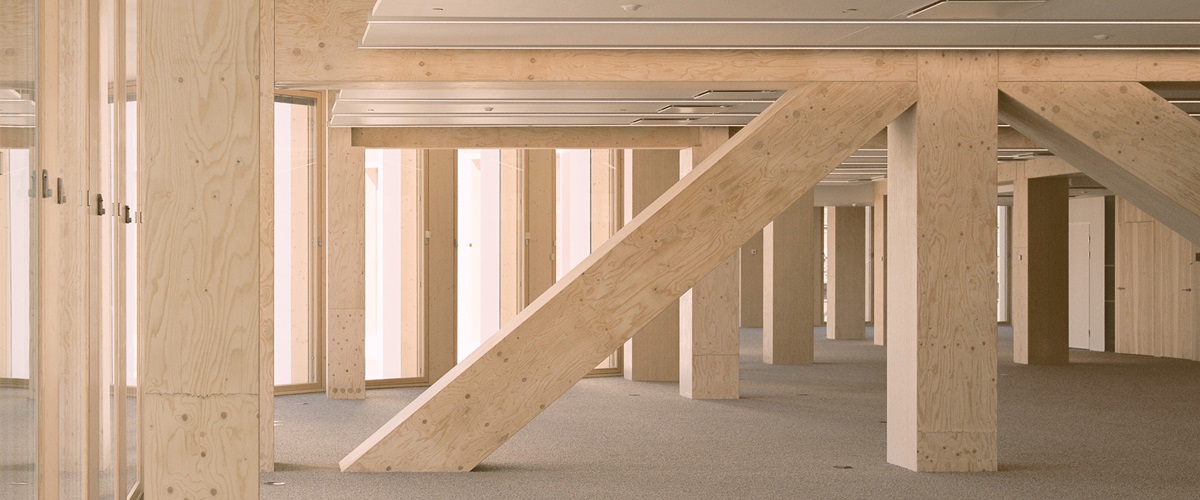
The building is owned by the Finnish pension insurance company Varma, and in addition to Stora Enso's head office, the premises host a hotel, a restaurant, and a café. Thanks to the beautiful work of Anttinen Oiva Architects and everyone involved, forest can be sensed from the ground up to the roof. The wooden elements are beautifully visible throughout the interior, honouring their nature-based origin. The rooftop of the building has been decorated with vegetation and deadwood that serve urban biodiversity.
Back to the roots: the forest behind the building
The Katajanokan Laituri structure is made of PEFC-certified Finnish and Swedish spruce from Stora Enso’s own forests and those of other forest owners. Trees are usually harvested at the age of 60–100 years. In harvesting, Stora Enso follows the principles of sustainable forestry and promotes certifications which set certain environmental, social, and economic requirements – such as preserving deadwood, living trees, buffer zones around waters, and other forest structures in harvesting.
These requirements are complemented by our own biodiversity management actions, and we monitor our performance with biodiversity impact indicators in harvesting, for instance. After trees have been harvested in final fellings, new seedlings are planted to ensure forest regeneration. In Northern forests, it takes only approximately 12 minutes for the 7,600 cubic meters of Katajanokan Laituri to grow back during a summer day.*
From carbon sink to carbon storage
The harvested trees are used as renewable materials by utilising each part of the tree in the most optimal, valuable, and resource-efficient way. For instance, timber is sawn and manufactured from the trunk of the tree. Katajanokan Laituri is built with around 7,600 cubic meters of massive timber, constructed with both LVL beams and columns (laminated veneer lumber) and CLT walls, floors and roofs (cross laminated timber).
Growing trees also bind carbon efficiently: the 6,000 tonnes of CO2 bound by the harvested trees are now stored in the walls and floors of Katajanokan Laituri, built to last at least a hundred years - while the new forest continues to grow. For comparison, the heating, cooling and other operations of the building will release the same amount of CO2 in 50 years.
Using wood not only stores carbon but also substitutes non-renewable materials like concrete and steel. The longer wood remains in use, the longer CO2 remains bound and the longer the material continues to bring a bit of nature into an urban environment.
* The growth has been calculated by dividing the amount of wood m3 used in the building with the estimated growth rate of forests in Finland and Sweden during the growing season (615.91 m3/minutes)