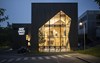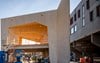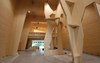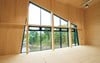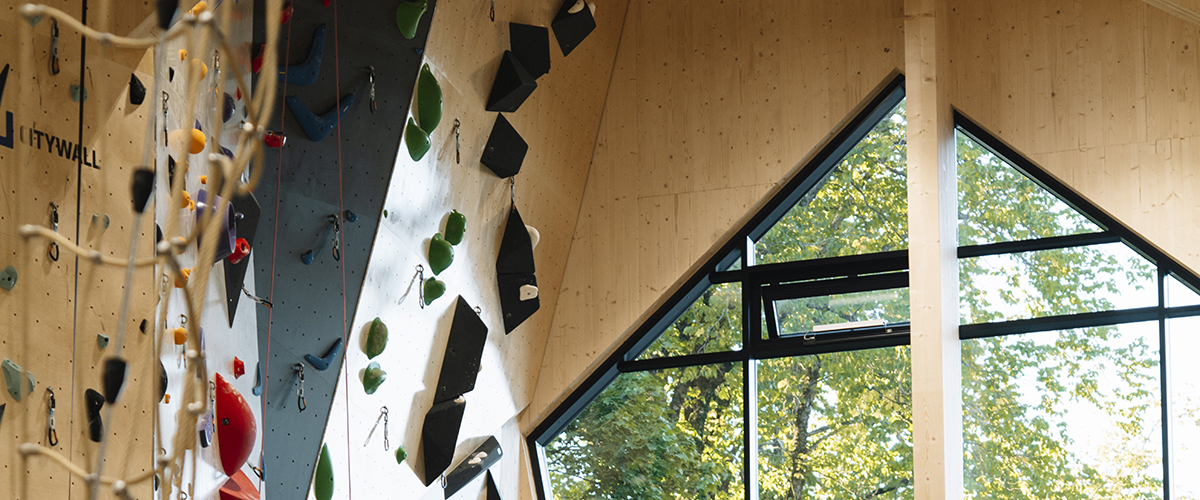
One of the reasons Høyt Under Taket was able to meet the project demands was a collaborative, open-minded design effort by a team with a passion for both mass timber and finding creative solutions. Architecture was led by Bård Stangnes, Senior Architect & Project Leader at Snøhetta, while structural engineering was the responsibility of Sondre Dolsvåg, Engineer at Degree of Freedom. Usefully for a project he describes as a “perfect fit”, Sondre happened to be an enthusiastic climber himself.
Another reason why the end product proved both eye-catching and fit for purpose was Sylva™ CLT Rib Floors and Roofs (hereinafter Sylva CLT Rib). Our prefabricated Sylva CLT Rib, which arrives on site ready to be installed, was the logical fit in two parts of the building where long spans and space considerations presented a particular challenge. The concept of using frames to create that ‘cave feeling’ in the main hall had implications for the ceiling and, in most parts of the building, limited the spans to six metres. The illustration below offers an overview of how these solid CLT (cross-laminated timber) frames fit into the building.

Illustration: ©Degree of Freedom
The exception to the six-metre ceiling spans was the highest ceiling in the building, located at the very back of the climbing area: this was a nine-metre span. It can be seen at left in the illustration above.
The other long span facing the design team was the mezzanine level above the reception area, which was a substantial 12.5 metres. Both areas are highlighted in the illustration below.

Illustration: ©Degree of Freedom
Why Sylva CLT Rib made sense…
Sondre explains why Sylva CLT Rib was ideal for purpose in these areas: “The main architectural feature in this building is the solid CLT frames used to enclose the space, with a frame geometry changing at each grid line to give the users the feeling of climbing inside a cave. The frames follow a certain grid spacing with a specific and unique geometry on each frame to create that feeling. We couldn’t – and didn’t want to – change this.”
“The reason we have Sylva CLT Rib in the high roof, with respect to the other parts of the ceiling, is the distance between the last frame and the second-last frame. That span is larger compared to the other spans.
“Then you have the mezzanine above the entrance area of the building. And again, here we have a large span. It’s 12.5 metres spanning from the outer wall to the central axis of the building.”
…and why the alternatives didn’t
Although mass timber had been specified by the client as the fundamental material of choice, various approaches were possible within that constraint. For the two parts of the climbing centre under discussion, thought was briefly given to other options.
“In the initial phases, we were evaluating up to three alternatives,” continues Sondre. “But you wouldn’t have managed that with ‘pure CLT’, even if you wanted to. I don’t think we could produce such thick CLT to actually bridge that span. It would have been so inefficient in terms of material use that it wouldn’t make sense at all.
“Another alternative was what we might call a ‘traditional’ CLT system, where you have load-bearing beams and you span CLT in the opposite direction between the beams. And on each side of the beams, you need either columns or a load-bearing wall. It was only one or two weeks into the discussions that we proposed Sylva CLT Rib as an alternative. Because it was very obvious for this project, to be honest. So we didn’t waste too much time before we actually took the decision.”
A question of efficiency
Although they had plenty of experience with CLT, Høyt Under Taket was the first time both architect and engineer had used our Sylva CLT Rib. Like Sondre, Bård was convinced by the efficiency for the challenge at hand.
“We had a six-metre grid in the middle of the building but the idea was to make it wider at the end to have an extra climbing route,” says the architect. “Extending the span to nine metres increased the structural load and deflection demands, so we needed a more efficient solution. That’s where Sylva CLT Rib came in – it allowed us to span the distance without adding beams.
“In a way, then, we had to work with a structural grid and also a climbing route grid. We placed our structure where it was structurally sound but also where it fitted according to the climbing width needed.”
Saving space and preserving the aesthetic
Aside from the sense it made from an efficiency and load-bearing perspective, Sylva CLT Rib also brought a benefit that is particularly important for a climbing centre. Any vertical space filled by structural elements – even right up in the ceiling area – is wasted space. It’s another reason why the ‘beams alternative’ was excluded from the concept at an early stage.
“At the back section of the building, you can see that the climbing walls go all the way up to the ribs,” says Sondre, with reference to the illustration below. “That was the consideration: if we introduced a very big beam to support the roof elements, we would enter the climbing and safety zones. You would lose the last metre and a half of climbing by having these big beams… instead of the many small ribs in Sylva CLT Rib.”

Illustration: ©Degree of Freedom
While climbers wouldn’t be in action beneath the mezzanine, saving space in this relatively shallow area was nonetheless a key part of the thought process.
“The alternative there would have been to have beams between the walls, and then switch the span direction of the slab elements. But the height of these beams would have been maybe a metre instead of the half-metre ribs. You would steal so much room height in the reception area.”
That reception area also provided an opportunity for the design team to show some added ingenuity in the detail. Having decided to go with Sylva CLT Rib, it hit upon the idea of using the rib structure to maximise ventilation efficiency. The spaces between the ribs could channel air into the area more effectively. This meant the ventilation system only had to be installed on one side rather than intruding into the room, where ventilation pipes would disturb the exposed wood aesthetic.
“That’s the best idea we had for using the structure with a purpose beyond just load bearing,” says Sondre. “I think it turned out well.”
A smooth workflow
That creative process was helped along by the fact that although the design team was using Sylva CLT Rib for the first time, they didn’t need to spend hours learning anything new around fire safety, acoustic or thermal aspects. Their experience of using CLT was enough. Connections between Sylva CLT Rib and the walls were also a case of following the Stora Enso guidelines, albeit with a couple of small adaptations to allow for the building’s specific requirements.
Using prefabricated wood always means most of the work is done up front. The Høyt Under Taket project was no exception, but the team found there was an efficiency to the preparation in these two parts of the building. Going through iterations to find the optimal Sylva CLT Rib deployment – number of ribs, size of ribs, CLT thickness, etc – was a painless process, says Sondre.
“Just by following the right steps, it was straightforward. There was a good amount of input data available. In the preliminary stages, we used product booklets and Stora Enso’s Calculatis software for evaluation. In the detailed design, a finite element model was used for analysis and verification of the timber structure.”