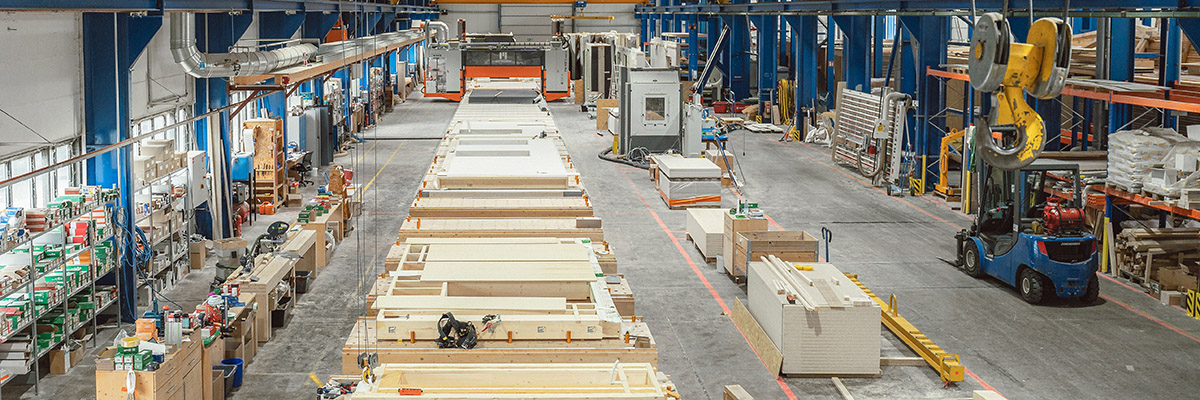
Photo: MAX Holzbau
The mission? To test carbon-storing construction materials under real-world constraints—tight budgets, strict regulations, and the growing demand for mechanised building processes.
This initiative emerged in response to the climate emergency and the urgent need to transform the construction sector. With around 60I% of raw material use and 40% of greenhouse gas emissions in Berlin attributed to construction, the city recognised that even energy-efficient buildings fall short if their materials are carbon-intensive to create, and thus the Holz Ziegel Lehm project was conceived to rethink how Berlin builds. (Source)
Practice-based research
The project is part of a broader research initiative funded by the Innovation Promotion Fund and supported by the Berlin Senate Department for the Environment, Transport and Climate Protection. It consists of two subprojects, each designed to test and compare sustainable construction methods in public housing.
A tale of two buildings
Subproject A is a development located at Alt-Britz 107. Here, two free-standing residential buildings with gable roofs were constructed on a shared plot. Each building rises five storeys above ground without basements.
It consists of 36 subsidised rental apartments with identical floor plans and volume. But the two buildings differ in construction method and material: one is realised as a mass timber skeleton structure, the other as a monolithic brick building. Both incorporate clay plaster for interior finishes, which essentially eliminates the need for air conditioning.
Both designs prioritise simplicity, durability, and robustness, using diffusion-open materials to eliminate the need for mechanical ventilation or air conditioning.
Both buildings are being scientifically monitored by TU Berlin, the University of Stuttgart, and TU Braunschweig to assess their long-term performance. This pilot project serves as a comparative study, evaluating both the carbon footprint and operational energy efficiency of the two distinct construction methods and will provide evidence-based data.
Subproject B is a development located at Buckower Felder, (Haus 5 Baufeld VIII, Berlin-Neukölln) and builds on the Typenhaus-Plus model, further developing it into a standard for sustainable housing. The building maximizes the use of timber in both structure and interior fit-out, while also incorporating recycled materials such as processed concrete.
Why contractors and developers should take note
At the core of the mass timber building is Stora Enso’s cross-laminated timber (CLT) system, delivered as the Sylva™ kit of parts. These precision-engineered components were preassembled by MAX Holzbau in their factory, resulting in impressive outcomes:
– Speed meets sustainability: Sylva CLT Walls and Floors enabled rapid assembly with minimal on-site waste
– Precision prefab: Manufactured to exacting standards, the Sylva elements reduced the margin for error and streamlined coordination
– Performance under pressure: The project demonstrated how mass timber can meet the rigorous demands of public housing—cost-efficiency, durability, and compliance with fire and acoustic regulations
A living lab
This project isn’t just a housing development—it’s a live research platform. By comparing the performance of the timber and brick buildings over time, the team is gathering valuable data on energy efficiency, indoor climate, and user satisfaction.
Early indicators suggest that Stora Enso’s Sylva™ kit of parts is not only holding its own but setting new benchmarks for sustainable construction.
Carbon footprint
The Sylva kit generated only 24 tonnes of CO₂e (greenhouse gases) to manufacture. Compared to the 341 tonnes of carbon dioxide that the trees removed while they were growing and will store at Alt-Britz 107 for generations, this amount is a small fraction.
Choosing Sylva CLT elements instead of non-renewables avoided 511 tonnes of greenhouse gases. Source: Stora Enso Carbon Calculator (based on third-party verified EPDs).
Wood Origins
The Sylva™ elements were made with wood sourced from PEFC-certified forests, ensuring that the timber used comes from sustainably managed forests. PEFC is one of the most trusted and widely recognised certifications for sustainable forest management.
Scale and replicate
The project shows that low-carbon-footprint construction is not only possible—it’s scalable. By using high-carbon-storing materials, the mass timber buildings are expected to reduce CO₂ emissions significantly. With scientific backing and real-world testing, this initiative offers a replicable model for future housing in Berlin and beyond.
Publications:
Video about the project: Holz Ziegel Lehm | Pilotprojekt Nachhaltiger Geschosswohnungsbau Berlin on Vimeo
Berlin.de: Zero Waste Wohnungsbau
Stadt und Land: Holz Ziegel Lehm - Baustart für den Nachhaltigkeitspiloten der STADT UND LAND in Alt-Britz
Read more about evidence based research with mass timber: Measuring Mass Timber - Built by Nature