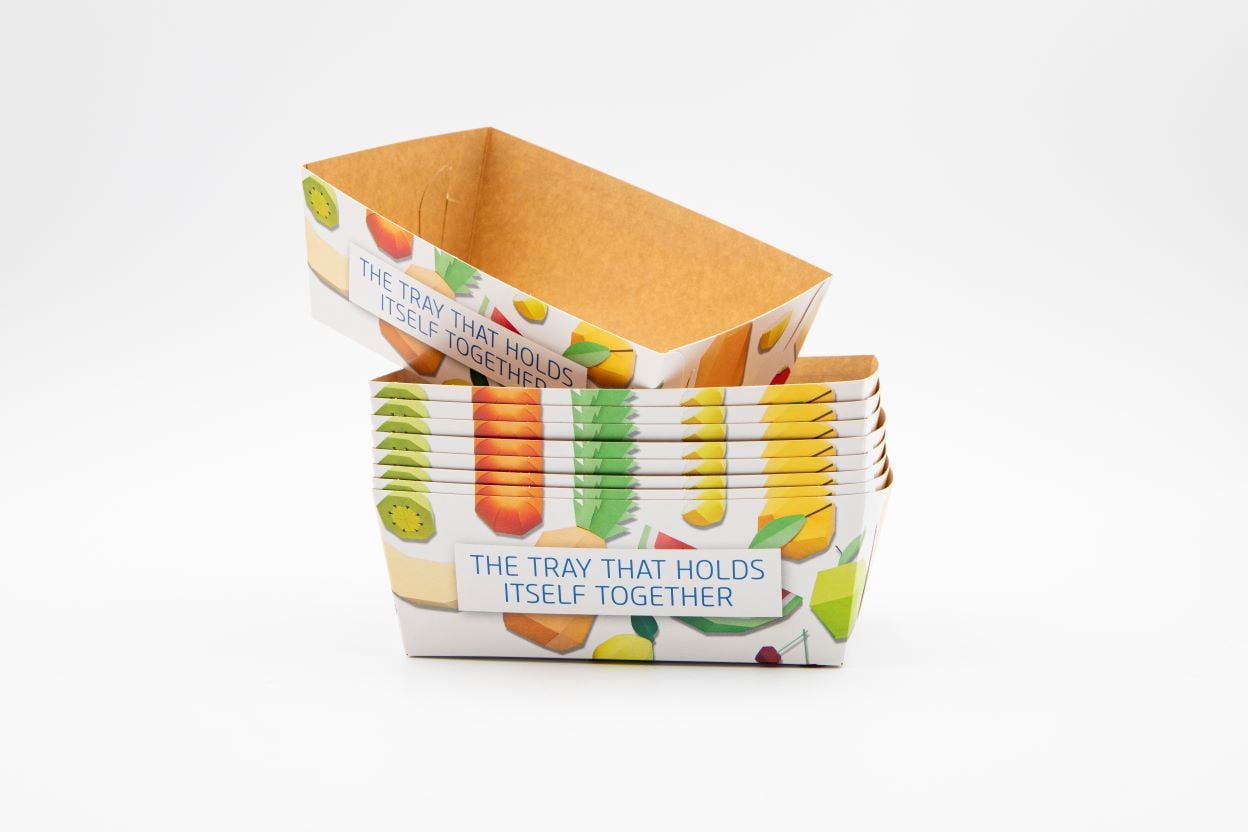
At high production speeds, even small differences in how the board folds, locks, or holds its shape can affect whether thousands of trays per shift come out correctly.For packaging converters, this gap between concept and repeatable performance has limited how widely glueless tray solutions have been adopted on fully automated lines.A joint development between German packaging machinery producer Heiber & Schröder and Stora Enso addresses this directly.
By developing machine design, tray geometry, and material performance as a coordinated system, the companies have produced a glueless tray solution based on Stora Enso's CKB kraft back board, running on Heiber & Schröder's CE Compact machine at speeds of up to 12,000 units per hour.
The challenge of consistency at production speed
Locking tray productionleaves little room for error. Every fold and every locking point must behave the same way -- not just within a single run, but across the full production process. If the board behaves differently under repeated use, or if the locking features do not engage properly, the result shows up in the finished package and interrupts the line.
In segments such as fresh produce, where packaging must survive automated filling, transport, and retail display, this need for consistency has kept adhesive solutions popular despite the additional process steps they require.
Reflecting on what made the development demanding, Jan Michaelis, CEO at Heiber & Schröder, explained: “The biggest challenge in this development has been to create a design and material combination that interlocks safely and at the same time runs at production speed on our tray former.”

Getting the forming process right
The development began with how trays are actually formed under production conditions, rather than with the locking feature itself.
On the CE Compact, each fold and locking point is guided into place as part of a controlled sequence, rather than relying on force alone to drive the material into shape. This is what allows the tray to come out correctly and consistently, even at high production speeds.
Notably, the solution was achieved not by building a more complex machine, but by doing the opposite. As Michaelis described: "The magic is in the fact that the CE Compact has been created by reducing the scope of the equipment rather than by extending it. The forming process is well proven and mastered by H&S. In fact, we are able to run interlockable trays on all our H&S tray erectors in the market by applying a specifically modified forming tool."
For packagersoperating the line, the practical result is greater stability across the process and less variation to manage between cycles.
The structural role of CKB by Stora Enso
In a conventional glued tray, adhesive performs structural work: it holds corners under load, compensates for minor variation in the board, and keeps the tray's shape intact through handling and transit. Without adhesive, all of that becomes the responsibility of the board itself.
CKB's stiffness allows the tray to hold its shape once formed, through the packing line, through transport, and on the retail shelf, without needing a heavier board grade to compensate. At the corners and locking points, where the most stress is placed on the structure, the board holds rather than deforms. Equally important is how CKB behaves when it is scored and folded. A clean, controlled fold is what allows the locking features to engage correctly and stay in place.
On how the material performs at speed, Michaelis noted: "The combination of material stiffness and surface characteristics enables a high-level folding process, allowing the equipment to run at up to 12,000 units per hour."
Pointing to the specific demands that locking construction places on the board, August Salo, Senior Packaging Designer at Stora Enso, added: "The physical locking mechanism relies on a different set of board properties compared to glued constructions. The through-board stiffness and tear resistance are key to ensuring a secure structure."

Operational implications of removing adhesive from the process
Eliminating adhesive affects more than tray construction. It changes how the production line is set up and managed. Without glue application, there is no dosing equipment to calibrate, no temperature to maintain, and no cleaning routines tied to adhesive systems. There are simply fewer things to monitor and adjust during a production run, and setup is more straightforward. The machine footprint is also smaller, since the space previously needed for gluing components is no longer required.
Removing adhesive not only reduces raw material consumption, but also preserves the tray's mono-material design, supporting efficient recyclability.
For producers in fresh produce or chilled food, that smaller footprint makes it practical to position the CE Compact close to the packing line. Speaking about what this means for customers in practice, Michaelis said: “By using a CE Compact with an interlockable tray, our clients are able to avoid all challenges that are typically associated with the use of glue on this equipment, which will significantly increase its availability. It makes the whole system easy to use and maintain so clients not previously used to running equipment of this type can possibly use it directly on-site where the tray is needed to be filled in the next process step.”
For brand owners, this means the packaging they specify can be produced more efficiently by their packing partner, with fewer steps between forming and filling.
Designed for produce, with flexibility beyond one segment
Fresh produce was the primary application driving the development, and the performance requirements of that segment shaped the system. The same characteristics that make the solution effective with produce -- structural stability, consistent output at high speeds, and on-demand tray forming close to the filling line -- apply across adjacent categories including chilled and fast food formats.
Looking ahead at where the concept could go next, Salo noted: "The locking tray structure could easily be expanded to more end-use segments such as take-away and fast food. Naturally, these may require introducing a barrier layer to the material to manage grease and moisture. Lids and closing features would also likely be a necessary addition."
From development to deployment
The glueless tray solution was introduced at Fruit Logistica and will be further presented at Interpack, 7-13 May 2026. At the same time, Heiber & Schröder will be demonstrating the tray running on a CE Compact machine during an open house at their facility in Erkrath, Germany, near the Interpack venue.
For Heiber & Schröder and Stora Enso, the collaboration reflects how packaging performance can be addressed through coordinated development across machinery and materials, with each element designed in relation to the other rather than adapted afterward.
For packagers, the outcome is a forming line that is simpler to operate and produces consistent output at speed. For brand owners, it is a tray that performs reliably through the supply chain, has a clean material composition, and fits within tightening requirements around packaging and sustainability.
The experience demonstrates how technical collaboration across the packaging value chain can turn a well-established concept into a practical, high-volume solution.


