In this interview, Maria Adolfsson, Business Development Manager for Barrier Business, talks about barrier boards. Barrier-coated products is a wide area, where Stora Enso offers a range of board grade and barrier combinations to support conventional and demanding product applications. With responsibility for barrier-coated products, focusing on packaging cups as an end use area, Maria maintains and develops the portfolio to match customer needs and legislation requirements.
1. One of Stora Enso’s key objectives is to accelerate the transition to a circular bioeconomy. How would you define circular bioeconomy and how can barrier boards contribute?
Circular bioeconomy is about managing Earth’s resources responsibly by keeping materials in circulation for as long as possible. With new processes, we can create a more circular and sustainable flow of resources. Barrier selection can influence how easily packaging materials are separated and processed in recycling streams. Developing board and barrier combinations that are compatible with existing recycling infrastructure is a key area of focus for Stora Enso.
2. What are packaging barriers and why do we need them?
A barrier is a functional coating or layer applied to paperboard that controls the transmission of, for example, moisture, oxygen, grease, or other substances. This protects the product, supports food safety, and helps maintain quality of the product over the intended shelf life. Choosing the right packaging material is essential, because it helps the food retain its quality and stay protected. For example, you would like your chips to be crispy and milk to taste as it should.
Different foods need different barrier types, determined by factors like moisture sensitivity, fat content, oxygen permeability requirements, and storage conditions. For instance, yoghurt needs a barrier to preserve flavor, retain moisture, and prevent the package from becoming wet or leaking. Dry pasta, by contrast, does not require a barrier.
3. During the summer months, many of us consume ice cream. What happens if you don’t have the right barrier?
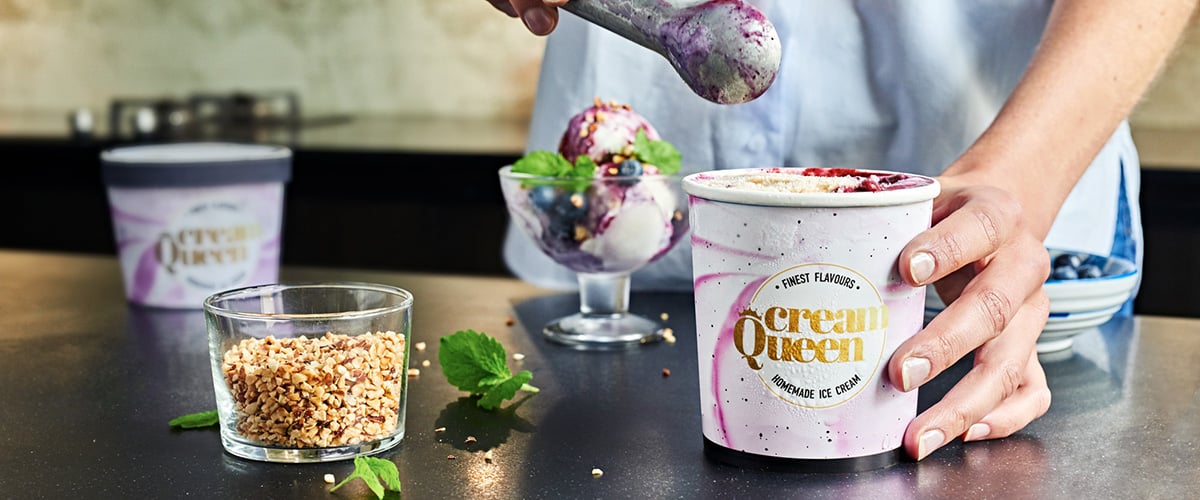
When talking of our materials, there are two end-uses for ice cream packaging. Frozen retail ice cream packaging, sold in supermarkets, and food service cups for takeaway. We offer barrier boards for both.
To preserve taste and texture, the packaging must protect the ice cream from losing moisture or structure. This can happen if the barrier is insufficient, or the packaging is not properly sealed. As a result, the surface becomes dry and the ice cream loses the smooth, soft consistency consumers expect.
4. What kind of barrier properties are important in retail ice cream packaging?
Frozen retail ice cream needs packaging with a moisture barrier to help maintain its quality over time. Freezing slows down chemical reactions and prevents food from breaking down, which means that frozen ice cream remains in a stable state. A good barrier against water vapor ensures that the ice cream keeps its properties – from taste and aromas to smooth structure. This barrier performance can be measured with WVTR (Water Vapor Transmission Rate).
With a sufficient barrier, and as long as the packaging is sealed and can handle moisture, it can store the ice cream for a longer period. The situation changes when the ice cream is served at room temperature. As the ice cream begins to melt, the packaging still should remain strong and tight, without softening or leaking. It’s important that the packaging performs in these varying conditions.
5. How does the takeaway environment differ from that of retail ice cream – and how does that impact the barrier board?
With takeaway, the ice cream is consumed straight away and often on the move. This means the packaging only needs to perform for a relatively short time. A lighter barrier is sufficient – yet the cup must be able to hold softened ice cream and prevent leaks in the summer heat.
6. What are the most crucial and common sustainability challenges or opportunities with barrier technology? Are products with barriers recyclable?
Today, barriers mainly come from fossil-based raw materials. The challenge is to replace these materials with renewable ones. Both barriers and barrier technology need to be developed, without compromising packaging quality. There are already barriers of renewable origin: an existing example in our portfolio is our PE Green. We also offer products with lower amounts of plastic, such as UltraThinPE TecTM products, which in most cup designs enable us to reduce the share of plastic coating to under 5%.
Products with barriers can be recyclable. The important thing is being able to separate the fiber part from the barrier part. With repulping tests, we can assess how the material will perform in real recycling conditions. Requirements for recycling and use of recycled materials are also increasing. By developing barriers that make recycling easy, we create good prerequisites for circular material flows.
7. From your perspective, what does it mean to be the renewable materials company?
Packaging is an obvious part of everyday life, yet often taken for granted. The choice of a product is today also a choice of the type of packaging material. Being the renewable materials company, we strive to develop products with the purpose to increase renewable content – reduce and replace materials of non-renewable origin – and simplify circular material flows.
8. What innovations do you expect next in barrier technology for cold and frozen applications?
Going forward, the key will be to match the right barrier to the right purpose.
By that, I mean using only the amount of barrier and type of barrier needed to protect the food, which will help reduce food waste. We already offer our customers a broad portfolio, tailored to their needs, and we continue to develop products and technology to meet future requirements. The development of barriers, not only for cold and frozen applications, is an exciting journey where we anticipate seeing a lot of progress ahead. Both for the circularity of materials and the protection of food.


