
From the Hackman era to international markets
Hackman & Co acquired Honkalahti Sawmill in 1910, opening a period of rapid growth.

From an early stage, it was understood at Honkalahti that the sawmill’s success would be built on the expertise and dedication of its people.

By the 1920s and 1930s, Honkalahti had become a sizeable local employer. Investments in new machinery, a planing mill and a box factory helped make further processing an important part of the sawmill’s operations.

From the war years through reconstruction and technological transformation
During the 1940s, Honkalahti produced not only sawn timber but also military bunkers and barracks, and after the war, wooden houses that were delivered to the Soviet Union as part of Finland’s war reparations. At the same time, a new power plant was built at the sawmill, using sawdust as fuel, and a railway spur connecting the site to Joutseno station was constructed. The sawmill and its employees played an active role in rebuilding Finland.
The 1950s and 1960s were marked by major investments: saw lines and sorting operations were modernized, kiln drying was adopted on a full scale, and annual production capacity increased to 150,000 cubic metres.

A forerunner in energy solutions and further processing
In the 1970s, Honkalahti also became a pioneer in energy solutions: in 1974, the sawmill became the first industrial facility in Finland to switch to natural gas as its primary energy source. At the same time, the company invested heavily in further processing, particularly in panel products and do-it-yourself products, which were exported extensively throughout Europe. During this period, the sawmill employed nearly 1,000 people.

In the 1980s and 1990s, operations were streamlined and production efficiency improved. Honkalahti became part of Enso-Gutzeit Oy in 1991, and further investments in sawline, finger-jointing and planing technology strengthened its position among Europe’s significant sawmills.

Modern sawmill with strong roots
In the 2000s and 2010s, Honkalahti has continued to focus on creating more value from wood. Today, the sawmill produces sawn timber and processed timber products, including glued and finger-jointed components for the window, door and construction industries.
A new power plant completed in 2017 enabled the site to stop using natural gas altogether.

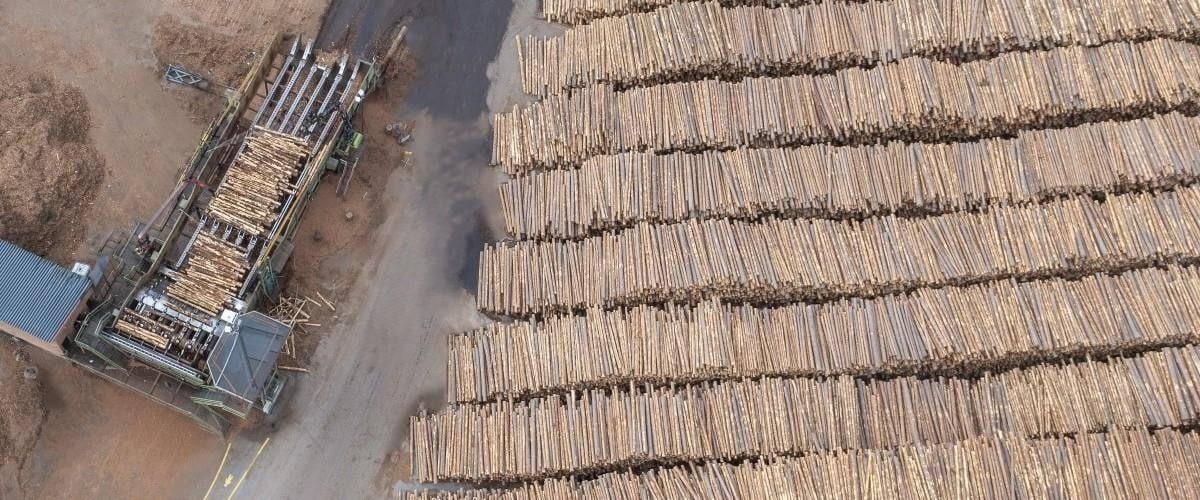
Today, Stora Enso’s Honkalahti sawmill has an annual production capacity of approximately 330,000 cubic metres of sawn timber and 70,000 cubic metres of further processed wood products. In addition to Europe, its products are exported to North Africa, the Middle East, Japan, the United States, and Australia.
The sawmill’s history is still reflected today in its strong sense of community and pride in workmanship
Today, the Honkalahti sawmill is part of Stora Enso’s Imatra Business Unit.
"The strength of the Honkalahti sawmill has always been its skilled and committed employees. The sawmill’s highly professional workforce helps us make even more efficient use of raw materials and supports our ambition to replace non-renewable materials with renewable solutions," says Janne Kallio, Head of Stora Enso’s Imatra Business Unit.

"For many people, our Honkalahti sawmill is much more than just a workplace. Generations have worked here, built a community, and shared in the everyday life of the sawmill. This 120-year history belongs above all to our employees – both former and current members of the Honkalahti community," says Ilkka Nuutinen, Mill Director of Stora Enso’s Honkalahti sawmill.


