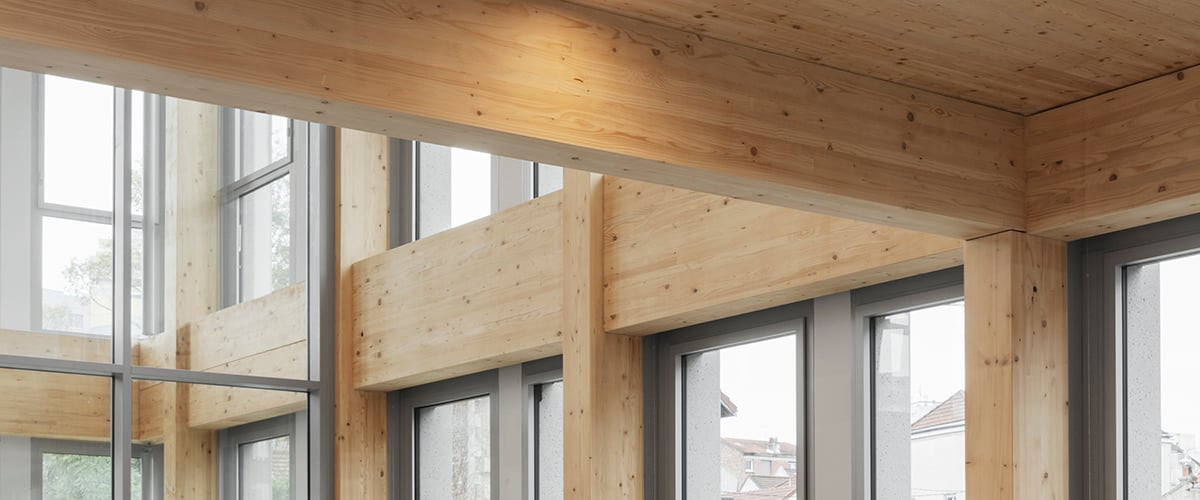
Photo: ©Schnepp Renou | Six Degrés
1. Record-breaking number of architectural awards for buildings designed and constructed with wood. Highlights include:
- Wisdome Stockholm, Dezeen, Kasper Salin, Canadian Wood Council.
- Stora Enso Head Office, Finnish Wood Award and inclusion in the inaugural UN Bio & Earth-Based Materials Compendium that was launched at COP29.
- 11 Belgrave Road, Retrofit Building of the Year 2024 Building Magazine Awards (G-frame Structures Ltd)
- Bezirksbauernkammer, Austria Archello (Innovaholz)
- Hope Street, 2024 RIBA MacEwen Award (EURBAN)
- Mediavaert ∣ DPG Media's new HQ, The Netherlands Timber Awards (WIEHAG Timber Construction)
- EcoDataCenter, Urban Land Institute Awards for Excellence (ByggPartner)
- 2024 was also the inaugural year for the Built by Nature Prize
2. Several major cities carried out urban planning and placemaking with engineered wood. President Macron opened Arboretum in Paris and Stora Enso delivered the mass timber kit of parts for the first building at Stockholm Wood City and Sydney’s Green City, near the new airport.
Paris, Lyon, and Vancouver (to name just a few of our favourites) developed affordable housing projects with mass timber, citing cost-effectiveness, speed and sustainability as the primary drivers.

Photo: Albizzia Woodeum x Pitch/©Kreaction
3. It wasn’t just buildings that were woodified. 2024 saw more wood-based telecom towers using laminated veneer lumber and other infrastructure, including wind turbine towers. Everything from road signs to satellites are going the woodway.
4. Tech breakthroughs: the world’s biggest fully automated coating line opened making it possible to apply prefabricated elements with protective coatings on a much larger scale.
5. Health and well-being took blueprint centre stage with Stora Enso setting a new benchmark with their new head office and the World of Volvo delivered with WIEHAG Timber Construction.
6. Mass timber classroom boom: Over a hundred new schools and educational extensions were built with prefabricated Sylva ™ kits, and GenZero Designed with Nature (a design for the disassembly (Dfd) initiative in the UK) also improved state schools. Our best of 2024 timber educational facilities included:
- B&K’s Stephenson Building, Newcastle University
- Madergia’s UPNA Health Sciences Building
- Pöchhacker’s VERBUND Hydropower - Apprentice Campus
7. All of this was by design on the policy level too. Legislative shifts advanced the use of mass timber in construction, including:
- The EU building sector was told loud and clear to get serious about low-emission and carbon-storing materials (aka wood) with the EU taking its boldest step yet to regulate the vast amounts of emissions in building materials.
- New legislation requires life cycle assessments (LCAs) for all new buildings, starting with large buildings in 2028, and requires all EU countries to set emission limits for new buildings from 2030.
- Supported by France’s Environmental Regulation 2020 (RE2020), prominent developers increasingly turned to mass timber to meet those legal requirements – and also likely to satisfy customer sustainability demands too. The Paris Olympic venues showcased demountable wood products and Falu Rödfärg pigment by Stora Enso.
- In Germany, the new Model Timber Construction Directive is on track to simplify the construction of wood buildings. The federal state of North Rhine-Westphalia has already applied this directive.
- In Canada, the Mass Timber Roadmap was introduced to increase the mass timber market to $2.4 billion by 2035, with $4.2 million allocated for mass timber demonstration projects and research now. Provincial building codes were also updated to enable mass timber buildings up to 18 floors.
- The U.S. increased funding to $74 million to spark innovation, create new markets for wood products, and expand wood processing facilities. (USDA)
- The Australian government’s $300 million fund launched in 2022 to accelerate the use of mass timber in medium and high-rise buildings started to take shape. Stora Enso and WIEHAG Timber Construction are shipping elements now to build the 39-storey Atlassian HQ in Sydney set to be the world's tallest commercial hybrid timber tower as this is written.
- Czechia approved the National Raw Materials Policy for Wood, which aims to accelerate the adoption of timber buildings.
- City mayors worldwide got serious about cleaner construction pushing for new finance models. Learn more in the ‘Money Issue’ podcast.
8. Lifecycle assessments went mainstream, boosting demand for carbon-storing, low-energy, and traceable building products; learn more about this in the Mass timber LCA-led design and construction case study.
9. Demand for more detailed carbon footprint information resulted in a wealth of new carbon counters, with Stora Enso’s calculator widely celebrated for showcasing their impressively small carbon footprint in a user-friendly way. Other standouts included Siemens’ ‘Decarbonization Business Optimizer’ and ‘One Click LCA’ comparing over a quarter of a million construction products.

Photo: Office of the Commissioner General CZ (for EXPO 2025) / Apropos Architects / ©ZAN studio
10. Participatory research initiatives, financial incentives and public awareness campaigns for building with wood captured our hearts and attention with stand-out examples, including a major collaborative effort resulting in the Commercial Timber Handbook tackling insurance, fire, moisture, Czechia’s pavilion at the World Expo in Japan (A2 Timber) Wood Circles, Alliance for Sustainable Buildings Map Project, European Wood Policy Platform (WoodPoP), New York City’s Mass Timber Studio. Climate Cleanup launched a methodology to certify the carbon stored in timber buildings (and Timber Finance Initiative made big strides with its soon-to-launch similar methodology). Under such approaches, developers can financially benefit from their buildings’ stored carbon if anyone still needs a reason to build in wood.
11. Green building badges: More mass timber buildings received prestigious sustainability certifications, such as LEED and BREEAM, recognizing their environmental performance and setting benchmarks for future projects.
12. Over 70 countries committed to the Chaillot Declaration to make near-zero emission and climate-resilient buildings the new global standard.
This is particularly encouraging given that 2025 is the year we’ll all learn if greenhouse gases have peaked or not, according to the Intergovernmental Panel on Climate Change. While that remains a big question mark, the year of the Wood Dragon has delivered us a wealth of certainty, with many bold and beautiful examples of how we can and are resisting climate change with sustainable wood products.
What did we miss?
We know there's so much more to say about this incredible year. What groundbreaking mass timber projects or sustainable design innovations happened in your region this year? Share your highlights with us and let's continue to inspire each other in our journey towards a more sustainable built environment.