Collaboration and partnerships
At Stora Enso, we work with customers and partners across the value chain to develop solutions based on renewable materials and improve material reuse and recycling. In our own operations, we aim to reach 90% material circularity by 2030.
Working together to advance materials based on renewable wood resources
The shift to circular, renewable materials happens when ideas, systems, and partners come together.
We work closely with customers, industry partners and organisations across the value chain to rethink packaging, develop alternatives based on wood-derived raw materials, and scale solutions designed to support material reuse and recycling.
Because circularity is about how our renewable materials move through the system.
Customer co-creation
Customer collaboration is at the core of how we innovate.
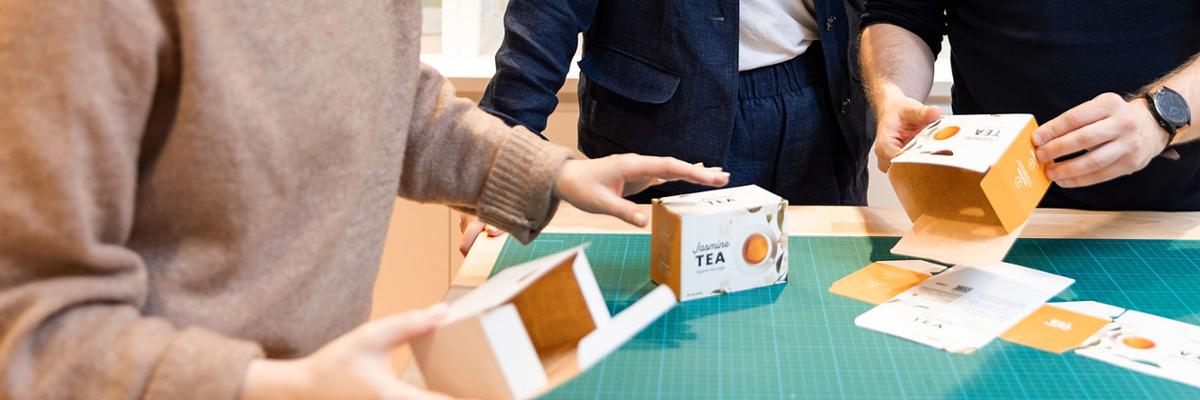
Together with customers, we develop paper-based and wood-based material solutions designed to meet specific application and performance requirements. Through joint development and testing, we work to take these solutions from idea to commercial production.
We bring together material expertise, design, and industrial capability to solve challenges, all the way from brand alignment and product protection to recyclability. Working with customers end-to-end, from the very start.
Value chain collaboration
Circular systems only work when every step is connected.
That’s why we collaborate across the value chain, from transparent sourcing to material production to collection, sorting, and recycling. Here is where we strengthen the systems that keep fibers in circulation.
This system thinking is essential to making circularity work in practice.
Industry partnerships for circularity
We are part of a broader effort to advance fiber-based circularity.
Stora Enso participates in industry initiatives such as 4evergreen, a cross-industry alliance developing harmonised technical tools, guidelines, and methods to improve and further increase the recyclability and recycling rate of paper-based packaging. Through these partnerships, we contribute to shared solutions that help align materials, infrastructure, and processes across the value chain.
Our approach to collaboration supports our broader ambition to reach 90% material circularity by 2030, embedding circularity across product design, production, and value chains. For this, we are working in close collaboration with the World Business Council for Sustainable Development and their partners.
Because scaling circular solutions requires collaboration beyond individual companies.
From collaboration with customers to circular outcomes
Collaboration becomes most meaningful when it delivers tangible results.
At the Ostrołęka site in Poland, Used Liquid Packaging Cartons (ULPC) are recycled into high-quality containerboard materials, keeping valuable fibers in circulation. The recovered fibers are used to produce new fiber-based products, supporting a more circular packaging system.
To maximise resource efficiency, the non-fiber components of liquid packaging cartons (LPC) are also recovered and recycled through a dedicated PolyAl recycling facility operated by Tetra Pak. This enables both fiber and non-fiber materials to remain in use for longer, reducing waste and increasing overall material value.
Through partnerships across the recycling ecosystem, we help turn used packaging into new resources – supporting our customers’ circularity ambitions and contributing to more resource-efficient systems.
That’s why we collaborate across the value chain, from material production to collection, sorting and recycling. Here is where we strengthen the systems that keep fibers in circulation.
Start-up spirit at Stora Enso
We value collaboration with startups as it helps us bring new ideas, technologies, and ways of working into our business. Through our partnership with Combient Foundry, Europe's largest venture client alliance, we connect with startups that can help address challenges and opportunities across areas such as environmental impact, circularity, digitalisation, artificial intelligence, and operational efficiency. Using a venture client approach, we work with startups to evaluate and adopt solutions that can create value for our business, customers, and value chains.
This collaboration has led to partnerships with companies such as Wiiste, Imagine Intelligent Materials, and Kreo, supporting innovation in areas ranging from construction and packaging to industrial operations. Through initiatives such as Startup Collaboration Day and targeted innovation challenges, we continue to explore new technologies and capabilities that can help strengthen our competitiveness, accelerate innovation, and support the transition to a circular bioeconomy.
Turning ambitions into practical solutions at world-class sports events
We also work with partners beyond our traditional value chains to introduce materials to new audiences. Through our long-standing sponsorship collaboration with the International Ski and Snowboard Federation (FIS), we raise awareness of wood-based materials and the role of material reuse and recycling at large-scale international sports events.

Since 2015, we have introduced wood-based materials into selected applications at the FIS Nordic World Ski Championships, showing how they can serve practical needs at large-scale sporting events.

Together, these partnerships connect every step, from material innovation and product design to recycling and recovery, helping to accelerate the transition to a circular bioeconomy.


